
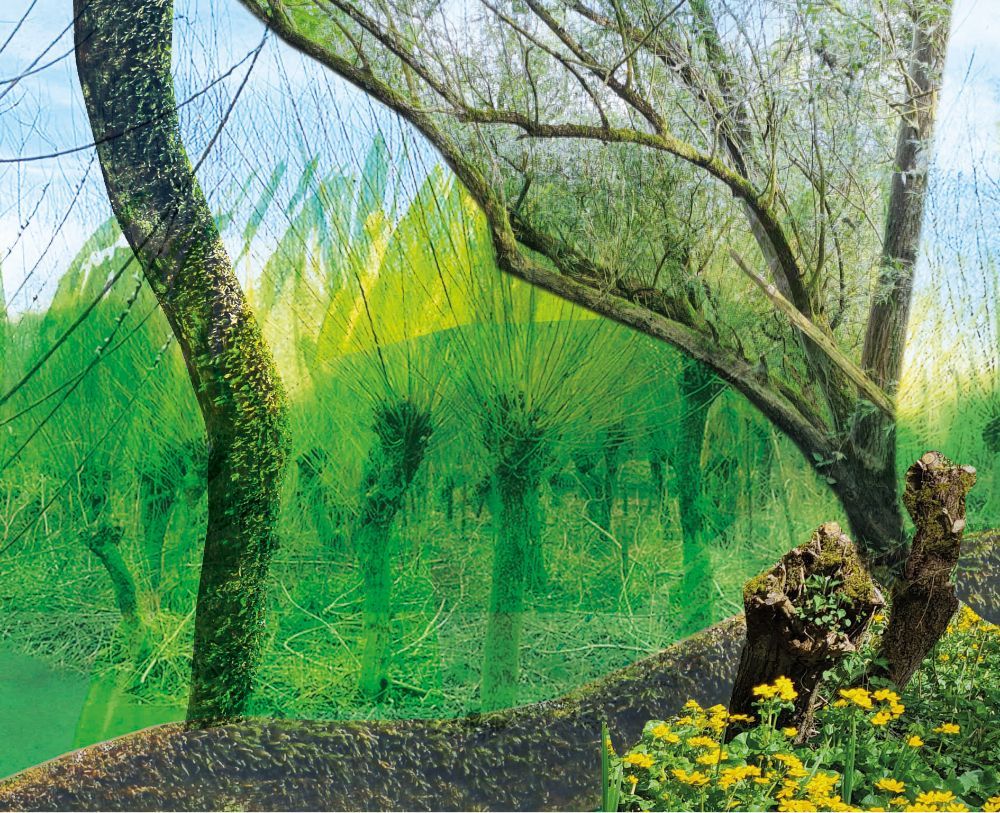
Willow
Willows can bloom as early as late February, early March. Most species found in our regions are easy to propagate. This way you can quickly expand the willow area. Willow workers knew this better than anyone else. All grienden were once managed for economic profit. The chopped wood served as "convenience wood": shovel handles, broom handles, meadow poles, hooping wood (for wooden barrels), battens and so on. The trade in brushwood is over. Nowadays, the Forestry Commission still processes some brushwood in sound barriers and sinks. In the Biesbosch, people now pay to have grienden cut. The heyday of brushwood culture is clearly over.
The willow is dioecious. Male flowers (with stamens only) and female flowers (with pistils only) therefore occur on separate trees. The striking yellow catkins attract numerous insects that thus cooperate in pollination. Seeds that land in a suitable place soon germinate. After the closure of the Haringvliet in 1970, sandbanks in the Biesbosch, which had permanently fallen dry, rapidly became overgrown with willows.
Just memorizing all the willow species is not an option. After all, there are more than 300 species. A few species can be recognized without much effort. The earliest flowering willow is the forest willow. The German dot is a bushy willow, the almond willow has a smooth bark, which "sheds" about every three years.
queen, worker and males. A mature colony consists of about 100 workers.

More on the campaign
This year marks exactly 30 years since the Biesbosch received national park status. Under the title De Biesbosch, B&B full of life, the Biesbosch network invites local residents and visitors to come and celebrate this anniversary with them.