A rich history
Where labor and agriculture were central

Today we know the Biesbosch primarily as a nature and recreation area. That was not always the case! Labor and agriculture used to be central to the Biesbosch for many.
Grooming
The "old" Biesbosch provided work for many men and women, and the area was used intensively. These different uses went more or less in parallel with the upwelling and silting of the area. In open water - after sedimentation - the first plants established themselves: rushes. The whole area owes its name to them! This particular (man-sized) matting rushes were commercially harvested and used for the manufacture of chair seats: who still remembers the craft of "chair matting"! Nowadays, rushes are no longer cut for commercial use in De Biesbosch, but here and there the mattenbies can still be found.
Cutting reeds
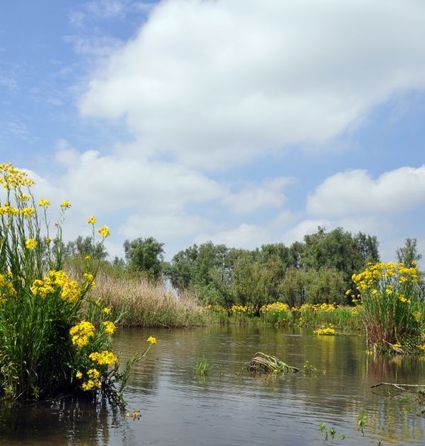
As the rush bunting (the overgrown land) silted up, the land became suitable for reed growth. The reed from De Biesbosch was known for its length. Forests of four, five meters long were the rule rather than the exception. Impressive! Every spring the reed buntings also turned butter yellow, due to the exuberant flowering of spindotters (flower). Like rushes, reeds are also no longer cut commercially in De Biesbosch today.
Grass, pasture and arable land
Due to the changing water regime (Delta Works) of De Biesbosch, the reedbeds were higher and drier. As a result, they became overgrown with shaggy herbs such as hedge bindweed, bramble and the hairy willowherb. A next step in the transformation of this area was to convert the reed bunting to (coppice) griend: wet fields. Plots were enclosed and with the help of culverts they regulated the water levels of the area. They then transformed these wet fields into agricultural plots. After clearing and milling the shrub stoves, the desired water level was achieved. The reclaimed land was used as grass, pasture or arable land. In recent years, agricultural polders have just disappeared again to make room for the river: an important aspect of nature development.

Griend chopping anno now
Until the closure of the Haringvliet (1970), the outer dike willows were regularly chopped. The wood had all kinds of functions: poles for in a meadow, hoop wood, tool handles and brushwood. Some grienden workers cut up to thirty different types of utility wood! Nowadays only a small amount of brushwood is cut: a total of about twenty hectares. On these coppice plots, comfrey, bitter cress, garlic-without-look, cow parsley, bittersweet and cave pipe grow in the ditches every spring.
Lush willow forests
With the disappearance of grienden culture, coppice bushes gradually changed into trees and coppice willows into lush willow forests. Typical of De Biesbosch are those crooked trees. As a result, the horizon of De Biesbosch rose some 25 to 30 meters "higher. The once massively growing nettles are now completely supplanted in places by the giant balsam: a herbaceous plant with pink and white flowers that grows up to 2.5 meters high. On the edges of the willow forests grow species such as hogweed, greater burdock, marsh weed, river weed and big cattail. All are beautiful plants with colorful flowers. Not suitable for cutting or chopping, but all the more to enjoy during your walking, cycling or boat trip through De Biesbosch!
That's the history of the development of the Biesbosch area in a nutshell. Have you become curious and want to know more? Then take a look in the Biesbosch Museum or in the old wicker worker's cabin on the Griendmuseumpad.